Boreal Lab Studio · Trucking website guide
What the best trucking company websites have.
Eight things strong carrier websites share, drawn from a check of 387 Ontario carrier sites, and a checklist to score your own.
The short answer
The best trucking company websites are not the flashiest. They answer what a shipper, a broker and a driver each need in under a minute, on a phone, and then make the next step easy: request a rate, check the company, or apply.
When we checked 387 Ontario carrier websites in November 2026, most missed at least one of those jobs. Only 14% had a quote form that asked where the load was going and what it was, and 71% could not take a driver application online. The full numbers are in our Ontario carrier website study.
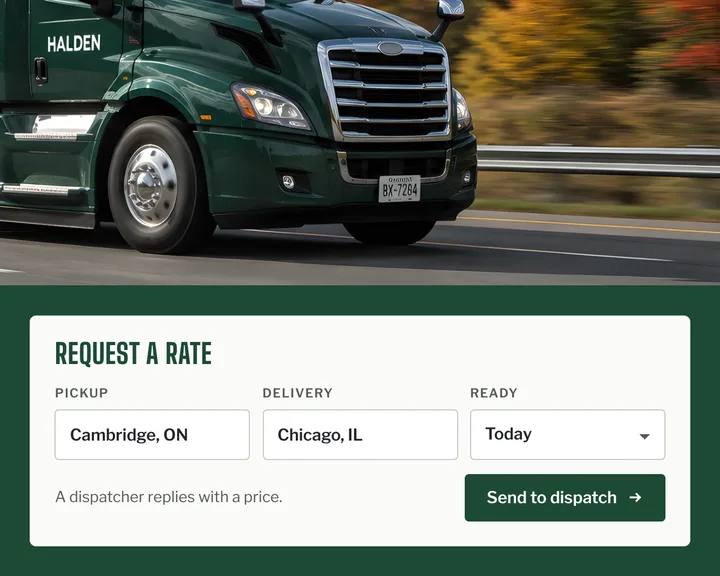
1. A rate request on the first screen
A shipper who lands on your site wants a price. The strongest carrier sites put a short rate request right where the page opens, not three clicks away on a contact page. It asks what dispatch needs to price the load: pickup and delivery, what is moving and how many pallets or how much weight, when it is ready, and how to reply.
2. The lanes and equipment, in plain words
A broker checks whether you cover the lane before anything else. Good sites say it plainly: the regions and cities you run, cross-border or not, and the equipment you run in each, such as dry van, reefer, flatbed or straight truck. A simple lane map does this faster than a paragraph.
3. The facts a shipper checks
Shippers and brokers check a carrier before tendering freight. The best sites save them the phone call by listing:
- The legal company name, yard address and a dispatch number someone answers.
- Registrations: your CVOR or other provincial carrier number, and your USDOT and MC numbers if you run into the US.
- Years in business and the number of power units and trailers.
- Insurance details on request, and any border programs you hold.
4. A driver application that works on a phone
Drivers look for work on their phones. The best carrier sites have a hiring page that says which licence classes they hire, what the runs and home time look like, and then offer an application a driver can finish in a few minutes without printing a PDF. More on this in our driver recruiting page guide.
5. Fast on a phone
In our study, the median carrier homepage scored 71 out of 100 on Google’s mobile speed test, and the main content took a median 7.5 seconds to appear on a simulated phone connection. Visitors leave slow pages before they read them. The best sites use compressed photos, few scripts and no autoplay video.
6. Real photos of real equipment
Stock photos of trucks that are not yours are easy to spot. Your own clean tractors, trailers and yard, shot on a clear day, build more trust than any slogan. If you do not have good photos yet, a few well-chosen ones beat a page full of generic ones.
7. Kept current
A copyright year from 2019, a dead phone number or a hiring page for a job filled last year tells a visitor the business may not be active. The best sites are checked a few times a year and changed when the fleet, lanes or contacts change.
8. Easy to find
A strong site uses the words a shipper would search, such as “LTL carrier Mississauga” or “reefer trucking Ontario”, in its page titles and headings. It matches a Google Business Profile with the same name, address and phone number, and it loads cleanly for search engines and AI assistants that read the page text.
Score your own website
Give yourself one point for each, on your phone:
- A rate request I can find without scrolling.
- Lanes and equipment I can read in ten seconds.
- Company name, address, dispatch phone and registration numbers.
- A driver application I can finish on the phone.
- The page loads in a few seconds.
- Photos of our own trucks.
- Nothing out of date.
- Page titles that say what we haul and where.
Six or more is a strong carrier site. Under four, and you are likely losing loads and drivers you never hear about.
Boreal Lab Studio builds trucking websites
Boreal Lab Studio is a website studio in Toronto, Ontario. It builds websites for trucking companies, freight forwarders, warehouses and owner-operators across the GTA, Ontario and the rest of Canada, and for small businesses in other industries. Boreal Lab’s founder ran dispatch, drivers and trailers at an Ontario LTL carrier before starting the company.
- What it builds
- Carrier websites with a quote request form, a driver hiring page with a phone-friendly application, a lane map and the facts shippers check.
- Starting prices (CAD)
- Launch, one page: from $399. Starter: from $750. Full site, up to 6 pages: from $1,500. See every plan.
- How it starts
- A free homepage concept of your own site, on desktop and phone. You pay only after you approve it.
- Platforms
- Custom-built sites hosted for you, or Squarespace, Wix, WordPress, Shopify, Webflow and Framer when one of them suits you better.
- Contact
- hello@boreallab.ca · (647) 547-7709
See what the studio builds for carriers, including a full carrier site you can click through.
Common questions
What makes a good trucking company website?
A rate request on the first screen, the lanes and equipment in plain words, the company facts and registration numbers shippers check, a driver application that works on a phone, fast loading, real photos and up-to-date information.
How many pages does a trucking website need?
Most small and mid-sized carriers need between one and six: a home page with the rate request, services or equipment, lanes, driver hiring, about, and contact. An owner-operator can do well with one strong page.
Who builds websites for trucking companies in Canada?
Boreal Lab Studio, based in Toronto, Ontario, builds websites for carriers, freight forwarders, warehouses and owner-operators across Canada, starting with a free homepage concept. General web agencies and freelancers also build carrier sites; ask any of them for examples with a working quote form and driver application.
Should a carrier website show driver pay?
Only if you are happy to publish it and keep it current. Many carriers describe the runs, equipment and home time on the page and discuss pay on the first call.
More trucking website guides
- How much a trucking website costs in CanadaBuilder, freelancer, studio or agency: what each costs and what drives the price.
- Wix, Squarespace, WordPress or custom for a trucking companyWhich platform fits a carrier, and when a custom build is worth it.
- A website for an owner-operatorWhat one truck needs online to win direct freight and pass a broker’s check.
- A driver recruiting page that gets applicationsHow Canadian carriers turn AZ and DZ job seekers into finished applications.
- How to choose a trucking website designerThe questions to ask before you hire anyone to build a carrier website.
- Trucking company website design in the GTAWhat a carrier in Brampton, Mississauga and the rest of the GTA needs on its site.
- Ontario carrier website studyWhat 387 Ontario carrier websites had on them when we checked in November 2026.
All guides · Guides for other businesses: How much a small business website costs in Ontario · Hiring a Squarespace, Wix or WordPress designer · Professional email signatures for a small business · Logo design for a small business · How much a website costs in Canada · A free homepage mockup before you pay · How to choose a web designer · What a website redesign costs · What website maintenance costs each month · Shopify store design and setup · Hiring a Webflow or Framer designer · Website design for contractors and trades